

Safety Management Systems
What Is a Safety Management System?
A Safety Management System is a formal, organization-wide approach to managing safety risk: proactive hazard identification and systematic risk management instead of reacting after an accident. It is not a binder on a shelf or a software subscription. It is a management discipline that gives leadership a continuous, data-driven picture of operational risk and a documented basis for every risk decision, rooted in ICAO Annex 19 and codified in the U.S. under 14 CFR Part 5.
The Four Pillars of SMS
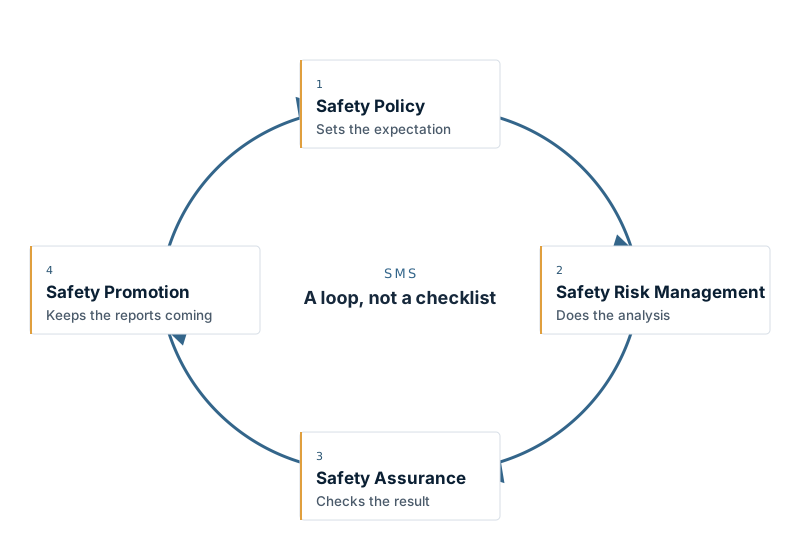
The four pillars form a continuous cycle. Safety Policy sets expectations. Safety Risk Management identifies and controls risk. Safety Assurance verifies effectiveness. Safety Promotion reinforces understanding and engagement.
Pillar 1: Safety Policy
Leadership’s commitment to safety, the accountability chain from the Accountable Executive down, and the answer to who owns safety.
Pillar 2: Safety Risk Management (SRM)
Identify hazards, assess likelihood and severity, and put controls in place that bring risk to an acceptable level.
Pillar 3: Safety Assurance (SA)
Verify that the controls are actually working, through performance monitoring, data analysis, auditing, and management review.
Pillar 4: Safety Promotion
Training, communication, and a culture where people report hazards without fear of punitive consequence.
How the Four Pillars Work in Practice
An operator adds a new city pair. Nothing about the airplane changes, but the pairing now has a 0500 report and a mountain approach the crews have never flown.
Safety Risk Management is where that shows up first. Someone has to ask what could go wrong on this route, how likely it is, how bad it would be, and what control brings it down to an acceptable level. A special-qualification briefing, a simulator session, a duty-time constraint.
Safety Policy is why that question gets asked at all. It set the expectation that a route change triggers an assessment, and named who is accountable if it does not happen. Without it, the new route simply appears in the schedule.
Safety Assurance picks up six months later. Are the briefings actually being given? What do the fatigue reports and FOQA data say about that 0500 report? An SMS without this step is a one-time exercise wearing a management-system badge.
Safety Promotion is what makes the crews tell you the truth at every step. If a captain who reports a near-miss on the new approach gets a phone call from the chief pilot instead of a thank-you, the other three pillars stop getting data.
That is the cycle: policy sets the expectation, risk management does the analysis, assurance checks the result, promotion keeps the reports coming. The four pillars are not a checklist. They are a loop, and the operators who get in trouble are the ones running it once.

A winter approach into Eagle County Regional Airport, Vail, Colorado.

Regulatory Timelines: Where Does Your Organization Stand?
The FAA’s April 26, 2024 final rule is the largest expansion of SMS requirements in U.S. aviation history. Two of the four deadlines have passed. The other two arrive in May 2027, and a functioning SMS takes longer to build than most operators expect.
DUE MAY 28, 2027
Part 135 operators and air tour operators (§91.147)
Must implement an SMS and submit a declaration of compliance to the FAA by May 28, 2027. Implementation plans were due November 28, 2024. Operators who have not yet submitted one are behind the regulatory curve, and the remaining runway for building a functioning system is shorter than it looks.
DUE MAY 28, 2027
Part 21 TC/PC holders
Implementation plans were due November 28, 2024, with full implementation due by May 28, 2027.
IN EFFECT SINCE MAY 28, 2025
Part 121 operators
Required to revise or implement an SMS meeting current Part 5 requirements by May 28, 2025. That deadline has passed. The question now is not whether a program exists but whether it demonstrably works, and inspectors are evaluating it on that basis.
IN EFFECT SINCE DECEMBER 31, 2025
Part 145 repair stations with EASA approval
Required to have an SMS fully implemented by December 31, 2025 under the U.S.–EU bilateral agreement (MAG Change 10). That deadline has passed, and oversight attention has shifted from whether a program exists to whether it demonstrably works.
The FAA evaluates SMS compliance on operational effectiveness, not documentation alone.
Deadlines current as of September 2026. Verify against current FAA guidance for any updates.
How SMS Engagements Work
Regulatory timelines and four-pillar frameworks are straightforward on paper. Implementation is not, and no off-the-shelf solution accounts for how different every organization’s culture, processes, and documentation maturity really are. I bring decades of Part 121 operational experience, Line Check Airman oversight, and a graduate background in Aviation Safety Systems and Human Factors to that gap. Whether you need a gap analysis against Part 5, full SMS development, or targeted work on a specific pillar, including the ASAP and FOQA programs that make Safety Assurance real, I do the work to a standard that holds up.

Is Your SMS Compliant? The Clock Is Running.
Every initial conversation is confidential, whether or not it leads to a formal engagement.
Schedule a consult
Practice Areas
© 2026 McCall Aviation Consulting, LLC. All rights reserved.